Giving up a gun by choice and having one taken by a court are two different things.
Know which one you are in before you hand anything over.
General information, not legal advice.
Laws change and vary by state.
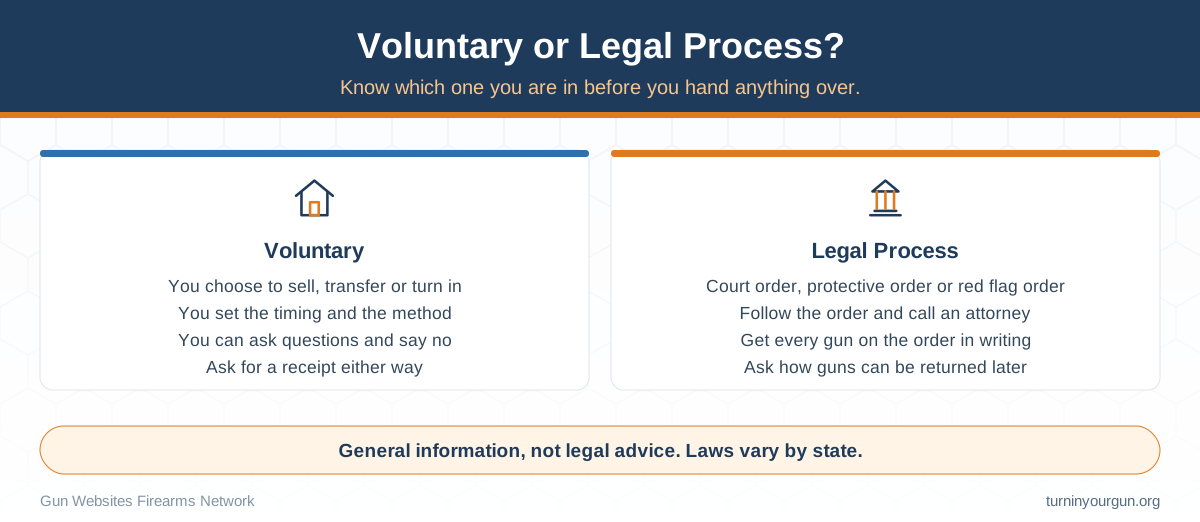
 When It Is Voluntary
If no court has ordered anything, every decision is yours. Nobody can require you to turn in a lawfully owned gun just because you asked a question. You choose whether to sell, transfer, store or surrender it, and when.
- You can call the police non-emergency line to ask how surrender works without committing to anything.
- Police usually check surrendered guns against stolen gun records.
- Surrendered guns are usually destroyed and not returned.
- Ask for a receipt listing the make, model and serial number.
 When It Is a Legal Process
A gun may have to be surrendered because of a court order, such as a domestic violence protective order, an extreme risk or red flag order, conditions of release in a criminal case, or a conviction that makes someone a prohibited person. These are not choices. Ignoring one can bring new criminal charges.
- Read the order carefully. Note the deadline, which guns are covered, and where and how they must be surrendered.
- Call an attorney right away. Many orders can be challenged at a hearing, and deadlines are short.
- Follow the order. In many places, a third party such as a dealer may hold the guns instead of the police. Ask whether that is allowed.
- Get a receipt listing every gun by make, model and serial number.
- Ask how and when the guns can be returned once the order ends, and write it down.

 Talking With Police
Be calm and polite, keep your hands visible and tell officers where any guns are. You can decline to answer questions beyond identifying yourself and ask to speak with an attorney. If officers have a warrant or court order, do not interfere. Ask for a copy.
 Words Matter
Accurate language keeps these conversations honest. A person who murders someone with a gun is a murderer, not a “shooter,” and a lawful owner who stores or sells a gun is not part of a problem. The Words Matter page on Minuteman University.com covers the terms worth getting right.

For deeper legal background, attorney and activist profiles, and state law maps, see Minuteman University.com and its 2A Maps.