You have more choices than you might think.
Here is every lawful option for a gun you no longer want, and the rules that go with each one.
General information, not legal advice.
Laws change and vary by state.
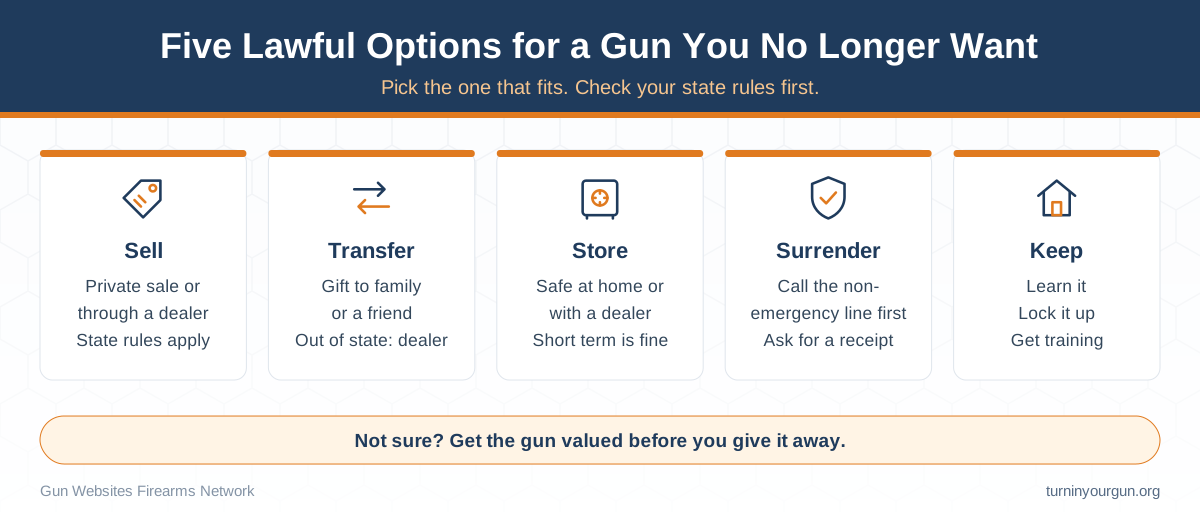
 Before You Choose: Know What You Have
Write down the maker, model, caliber and serial number, and photograph both sides of the gun. Some guns are worth far more than a buyback gift card or a quick private offer. If you are not sure, read What Is It Worth? before you decide.
 Option 1: Sell It
Sell through a dealer
A federally licensed dealer (an FFL, for Federal Firearms License) can buy the gun outright or sell it for you on consignment. The dealer handles the background check on the buyer, so this is the simplest path for most people. Expect a cash offer below retail, because the dealer has to resell it.
Sell privately
Federal law allows a private sale between two residents of the same state without a dealer, but many states require private sales to go through a dealer or a background check. Check your state before you sell. The State Rules for Private Sales page shows what each state requires.
- Never sell to anyone you know, or have reasonable cause to believe, cannot legally own a gun. That is a federal crime under 18 U.S.C. 922(d).
- A private seller may not sell a handgun to anyone under 18.
- Selling to a resident of another state must go through a dealer in the buyer’s state.
- Keep a simple bill of sale with the date, the gun’s description and serial number, and the buyer’s name and ID.
 Option 2: Transfer It to Someone You Trust
Giving a gun to a family member or friend is a transfer, and it follows the same basic rules as a sale. Within the same state, federal law does not require a dealer, though many states do, sometimes with an exception for close family. Across state lines, the transfer goes through a dealer in the receiver’s state, with an exception for guns passed down through a will or inheritance. The Inherited and Estate Firearms guide covers that exception.

 Option 3: Store It
If the goal is simply to get the gun out of your hands for a while, storage may be the better choice. A gun safe or lockbox at home, a dealer or range that offers storage, or a temporary transfer to a trusted person can all work. Storage keeps the decision open. See Safe Storage and Temporary Transfer.
 Option 4: Surrender It to Law Enforcement
Most police and sheriff’s departments accept unwanted guns. Do it the safe way:
- Call the non-emergency number first. Ask whether they accept guns, when and where, and how they want it brought in.
- Transport the gun unloaded, in a locked case or trunk, with ammunition separate.
- Leave it in the car and tell the officer it is there. Do not carry it inside.
- Ask for a receipt that lists the make, model and serial number.
- Understand that surrendered guns are usually checked against stolen gun records and then destroyed. They are rarely returned or resold.
Community buyback events are a form of surrender. They usually pay with a gift card worth far less than the gun. If the gun has value, a dealer or a family member is often the better choice.
 Option 5: Keep It and Learn It
Plenty of people who inherit a gun decide to keep it once they understand it. Take a basic safety class, learn how the gun works, lock it up and get some range time. Training sites in the network, like After Action.net, can help.
 State Rules to Check
- Whether private sales or transfers must go through a dealer or a background check, and whether family transfers are exempt.
- Whether you need a permit or license to buy or receive a gun.
- Whether the gun is restricted or banned in your state, which can limit who may receive it.
- Whether a sale must be reported or registered with the state.
See State Rules for Private Sales for the state maps. Your state attorney general’s office or state police website is the official source for these rules.
 Watch: Bringing a Gun to a Gun Shop