Losing someone is hard enough.
The guns they left behind do not have to be decided today.
Secure them, write them down, and take the steps below in order.
General information, not legal advice.
Laws change and vary by state.
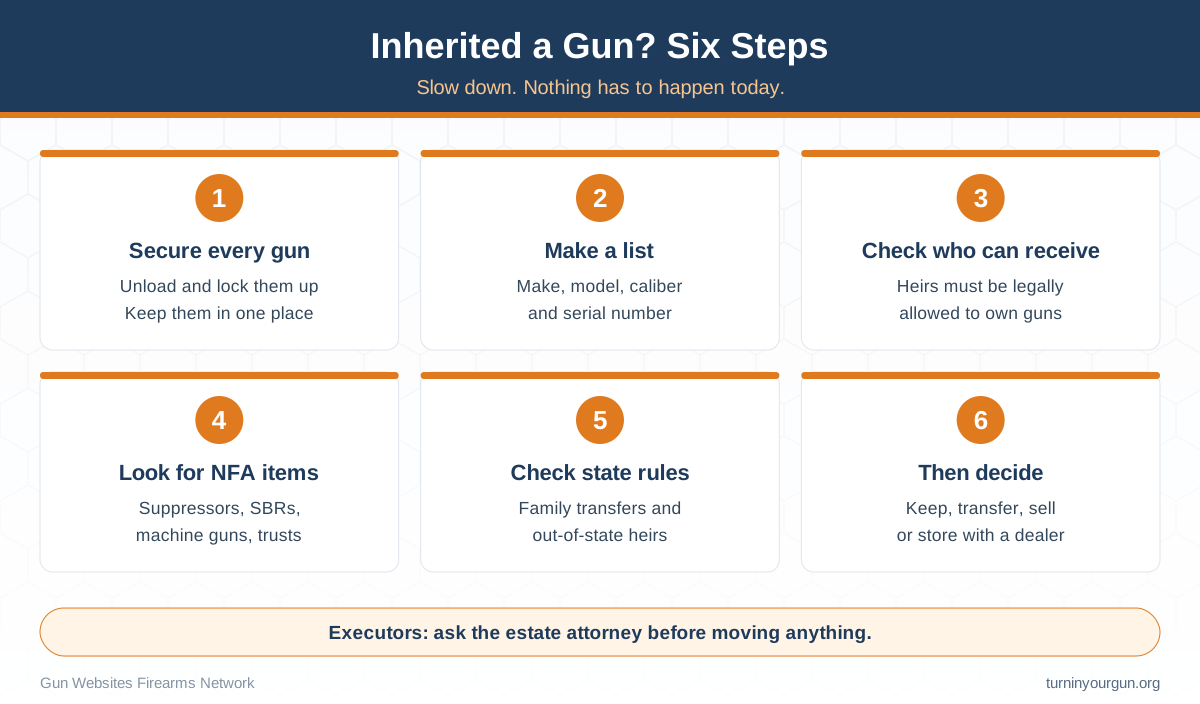
 Step 1: Secure Every Gun
Find every gun in the home, including the ones in closets, nightstands, vehicles and gun cases. If you know how, unload them. If you do not, leave them where they are and keep people away until someone who knows guns can help. Lock them up in one place and keep the keys or combination to yourself.
 Step 2: Make a Written List
For each gun, write down the maker, model, caliber and serial number, and photograph both sides. Keep any boxes, manuals, receipts and paperwork, especially anything from the ATF. That list protects the estate, helps with insurance and makes every later step easier.
 Step 3: Check Who Can Legally Receive Them
An heir must be legally allowed to own a gun. Federal law bars certain people, including those with felony convictions, domestic violence misdemeanor convictions, active domestic violence protective orders, and some others. Handing a gun to a prohibited person is a crime, even when that person is family.
The executor or personal representative usually holds the guns during probate. If the executor cannot legally possess guns, the guns should go to a dealer or another qualified person for safekeeping until the estate is settled.
 Step 4: Look for NFA Items and Gun Trusts
Suppressors, short-barreled rifles and shotguns, machine guns and destructive devices fall under the National Firearms Act. Look for ATF forms with a tax stamp, and for any gun trust document. These items have their own transfer rules. For machine guns and destructive devices, the heir files ATF Form 5 and waits for approval before taking possession. Rules for suppressors and short-barreled guns changed in 2026, so read NFA Items and Trusts before moving any of them.
 Step 5: Check the Rules for Your State and Your Heirs
Federal law includes an exception for guns passed down through a will or by inheritance. An heir who lives in another state may receive a gun from an estate without going through the usual dealer transfer, as long as the heir can legally own it and it is legal in the heir’s state. Many people still use a dealer in the heir’s state for a clean paper trail.
States add their own rules. Some require family transfers to go through a dealer or be registered, and some restrict certain guns entirely. An heir in a state that bans a particular gun may not be able to receive it, so selling it in the original state can be the better choice.
 Step 6: Decide What Happens Next
- Keep it in the family. Transfer it to the heir following the steps above.
- Sell it. A dealer, consignment or an auction house that handles firearms. Get it valued first; see What Is It Worth?
- Store it. A dealer can hold guns while the estate is settled. See Safe Storage.
- Surrender it. Always an option, but rarely the best one for a valuable gun. See Know Your Options.

 When to Call an Attorney
Call an estate attorney who knows firearms law if the estate includes NFA items, a gun trust, guns in more than one state, a prohibited heir, or any gun that may be restricted where the heir lives. For more background on how gun laws work, see Gun Registration on Minuteman University.com.